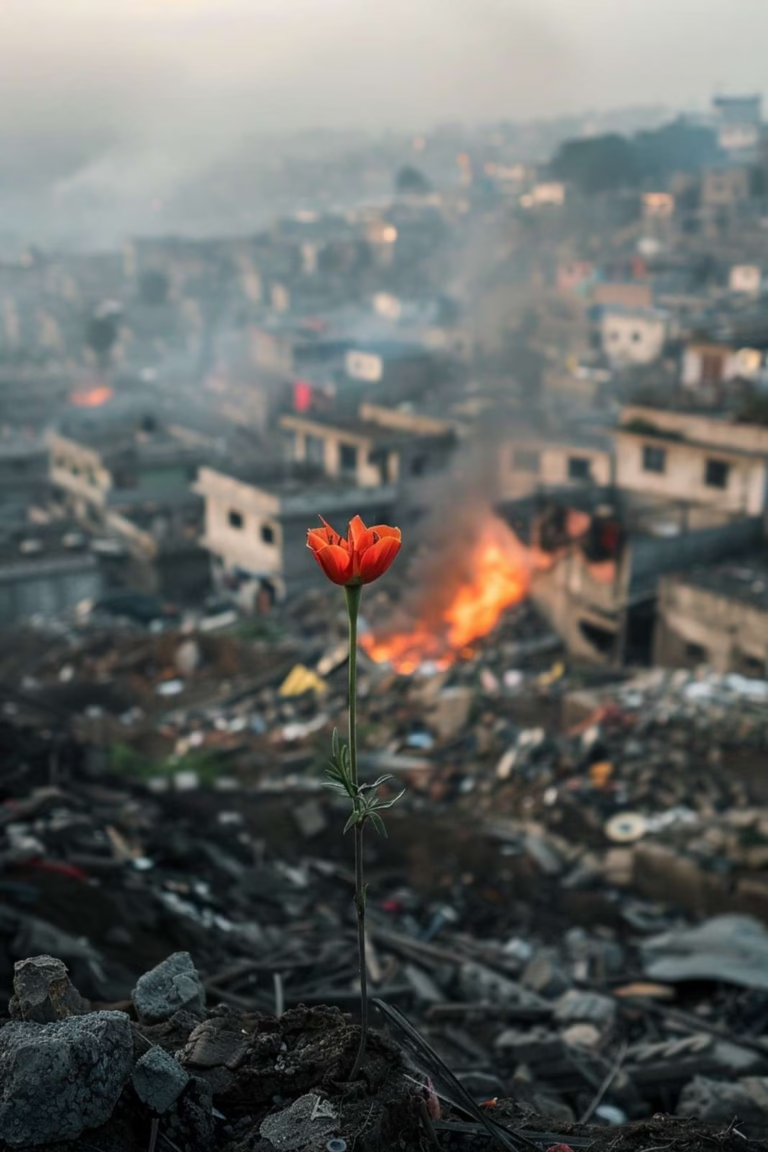


In God We Do Not Trust: Lost Faith, Lost Focus And Surviving the Hope Crisis


TLDR
Trust doesn’t require certainty about the future. It only requires a willingness to believe that the One who built tomorrow is the same One who carried you through yesterday.
I know exactly what to do, how to do it, BUT I can’t do it!
There’s a heaviness I carry that I can only describe as a toxic lack of motivation: no energy, no hunger, no ambitious drive. At first, I thought it was laziness. Then I thought it was depression. But the longer I sat with it, the more I realized what it actually is: I don’t trust the future, even worse, I can’t unsee a dark future,… so why bother!
And here’s the strange part — my present is genuinely good. A hundred times better than the frightening future I once imagined for myself growing up as a kid or a teenager. By any honest measure, I have been given more than enough. And yet I cannot just learn from it and picture a similar good tomorrow. I can’t begin to imagine good days ahead for me or my dreams. I cannot feel it.
And honestly, for a believer in God, this confession runs deeper than anxiety or confusion.
For a believer, the future is just another name for God.
What I am really confessing above is this: I don’t trust God’s plan for me — even if God has been nothing but generous with me, nothing but merciful to me in my darkest hours.
So where does this distrust come from? How does a person who worships a Merciful, All-Powerful, and All-Knowing God still flinch at the thought of what’s ahead?
Projecting Islamic teaching onto our way of life nowadays points to three clear sources, and the more I reflected on them, the more I recognized myself in each one:
1- The Fog
The first one is about our desires, and it’s quiet and sneaky; it doesn’t announce itself.

Trusting God is not merely a feeling — it’s a relationship. And like any relationship, it has terms: You do your part; God does His. But when we break those terms — when we give in to what we know we shouldn’t, when we choose our desires over our wellbeing — something in us shifts.
Consciously, we tell ourselves stories. We rationalize, minimize, and explain away our desire-driven actions. But the unconscious is not so easily fooled; deep beneath the surface, guilt pools into insecurity, and insecurity transforms into dread. We begin to expect punishment because, on some level, we believe we deserve it. The “unconscious deserved dark future” becomes a fog we can’t see through.
This is the subtle cruelty of sin: it doesn’t just hurt the present, it darkens the horizon.
2- The Whisperer
This one is ancient, and God warned us about it repeatedly.
The Quran is clear on this: one of Satan’s primary weapons is despair.
When desire and temptation cannot cause you to fall, the devil switches tactics: he whispers of poverty and promises suffering. He tells you the future is already sealed in darkness, that you are alone and weak, so why bother? Why try? Why resist?
The whisper takes many forms:
“It won’t work out for you.”
“Sinful people like you don’t get good endings.”
“Enjoy what you have now, it’s all downhill from here.”
This is not pessimism; this is spiritual sabotage. And it is designed precisely to make you either give up entirely, or act recklessly out of fear — both of which lead to the same ruin.
“The Devil threatens you with ˹the prospect of˺ poverty and bids you to the shameful deed ˹of stinginess˺, while Allah promises you forgiveness and ˹great˺ bounties from Him. And Allah is All-Bountiful, All-Knowing.”
Quran 2:268
3- The Fortune Teller
The last one is new, but perhaps the most relentless.
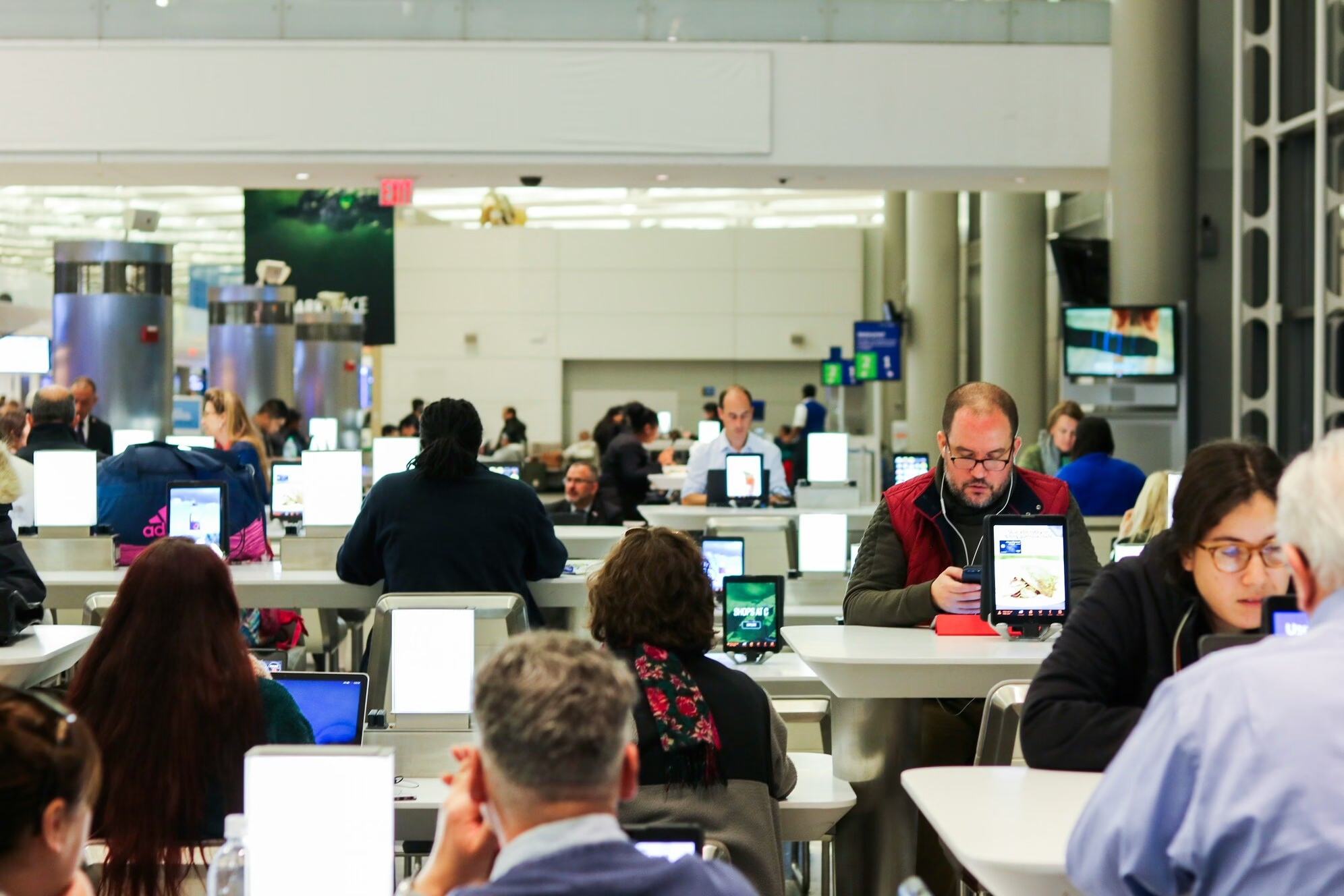
We have built a machine, many machines, actually, that feed us fear as a lifestyle: The News, Social media, the endless scroll: these are not neutral windows onto the world; they are architecturally designed to hold your attention through alarm and addiction.
This is what I call our pseudo-God, our uninterrupted fortune teller: the media that tells us what to fear, what to want, and what to expect, burying the Divine voice that speaks of providence, sustenance, and protection under a shiny dump of insecurity and fear.
War, collapse, economic stress, diseases, distrust and stupidity… Threat after threat, loop after loop, until you begin to feel that the present is already lost and the future is the inevitable collapse that logically follows.
And by force of repetition, it wins. It convinces you that stress is wisdom, that accumulation is safety, that vigilance is virtue. It tells you: forget about fixing what’s in front of you, just prepare for what’s coming.
And slowly, without noticing, we stop trusting. Not just the future, not just people, but God.
So What Do We Do?
I’m not a productivity guru, and I am not going to pretend there’s a clean five-step solution. Because I’ve come to believe the path back to trust is less about doing more and more and more about removing what’s breaking us. And here is what I keep returning to for each problem above:
1. Reduce The Noise
Start here because it touches all three causes at once
Since the media of our age is, and I don’t say this lightly, the intersection of everything that erodes faith: it amplifies our worst desires, it operates on all of Satan’s favorite currencies (fear and despair and/or lust and desires), and it replaces God’s narrative of mercy and provision with a never-ending apocalypse reel.
Turn it off. Or at least, radically reduce it.
If you really care about what’s happening in the world, look around you: ask your neighbor how they’re doing, check in on your parents, pay attention to the people who are directly in your life and be part of a community.
And believe me, when/if bad things happen close to home, those real connections are the only investment and backup that will ever truly matter.
2. Preserve Your Connection with the Sustainer
As a Believer (Muslim), the toolkit here is ancient and proven against the Devil’s schemes:
Pray, not as a ritual of obligation, but as a genuine conversation, a reaching out toward the One who sees you and knows all about you and your situation.
Read the Quran, not to finish it, but to learn the Divine laws and patterns that govern nations and individuals before you, to rediscover God’s mercy with his creation.
Remember God often, in the small moments, the ordinary hours. This is what remembrance of God (dhikr) does: it keeps the channel open so that the whispers of doubt and despair can’t fill the silence.
And ask God, sincerely and specifically, to protect you from evil’s reach.
3. Make Peace with Your Own Contradictions
And this is the hardest one.
I call them contradictions because, in the case of desires, you are both the one who hurts and the one who is hurt, the oppressor and the oppressed. And It hides under schemes and persistence.
And the solution is not always stronger willpower.
Sometimes the solution is distance. This is a lesson from God. His guidance in the Quran is not simply “don’t do it” — it is “don’t even come near it.” And the distinction matters enormously: the cure is not just internal resistance and determination; it’s environmental consciousness.
No acceptance or adaptation to social or workplace corruption. No apps or devices that make access to sin frictionless. No closed-door situations that incite temptation. No circles of friends who normalize sin…
Instead, build an environments that make righteousness easy, natural and even enjoyable.
Add to that: Repent regularly, make it a practice, not an event. And then look forward to building the conditions and environment for a virtuous life, brick by brick.

A Final Word
I began this not knowing quite where I’d end up. But I think what I’ve found is this:
The future is not just “the future,” it is Allah’s plan. Allah’s promise. Allah’s wisdom unfolding through time.
And Allah has not changed. His promises have not changed. What’s changed is the noise around us, and the distance we’ve allowed to grow between our real selves and the One who created us.
Come back to that. Even a little. Even imperfectly.
Trust doesn’t require certainty about the future. It only requires a willingness to believe that the One who built tomorrow is the same One who carried you through yesterday.
“And whoever is mindful of Allah, He will make a way out for them, and provide for them from sources they could never imagine. And whoever puts their trust in Allah, then He ˹alone˺ is sufficient for them. Certainly Allah achieves His Will. Allah has already set a destiny for everything.”
Quran 65:2-3
Written by a person trying, like everyone else, to find their path.