

The Myth of Life Balance: An Islamic Perspective


TLDR: Is Happiness a Zero-Sum Game? What are you willing to sacrifice to achieve balance, and what do you desire most?
There’s a woman in your city right now. Let’s call her Sara. She drives a car that turns heads, lives in a penthouse with a view, and when she walks into a room, people notice. From your window, your ordinary apartment, your Monday-morning commute, her life looks perfect. Like a puzzle where every piece found its home.
But Sara hasn’t slept properly in three years. Her children call her twice a month, and the conversations are short and cold. She sees her doctor more often than her friends. And at 3 AM, in the silence that money can’t fill, she stares at the ceiling and feels it — that vague, persistent ache that tells her something is still, somehow, missing.
You know this story. You’ve seen it in real people, read it between the lines of interviews, and watched it unfold on screens. Maybe you’ve felt some version of it yourself. The feeling that the more you get of one thing, the more another quietly slips away.
That the universe is always, somehow, collecting.
The theory that explains it has no official founder, no single book. But it whispers through everyone’s imagination.
The Life Balance That Haunts Us
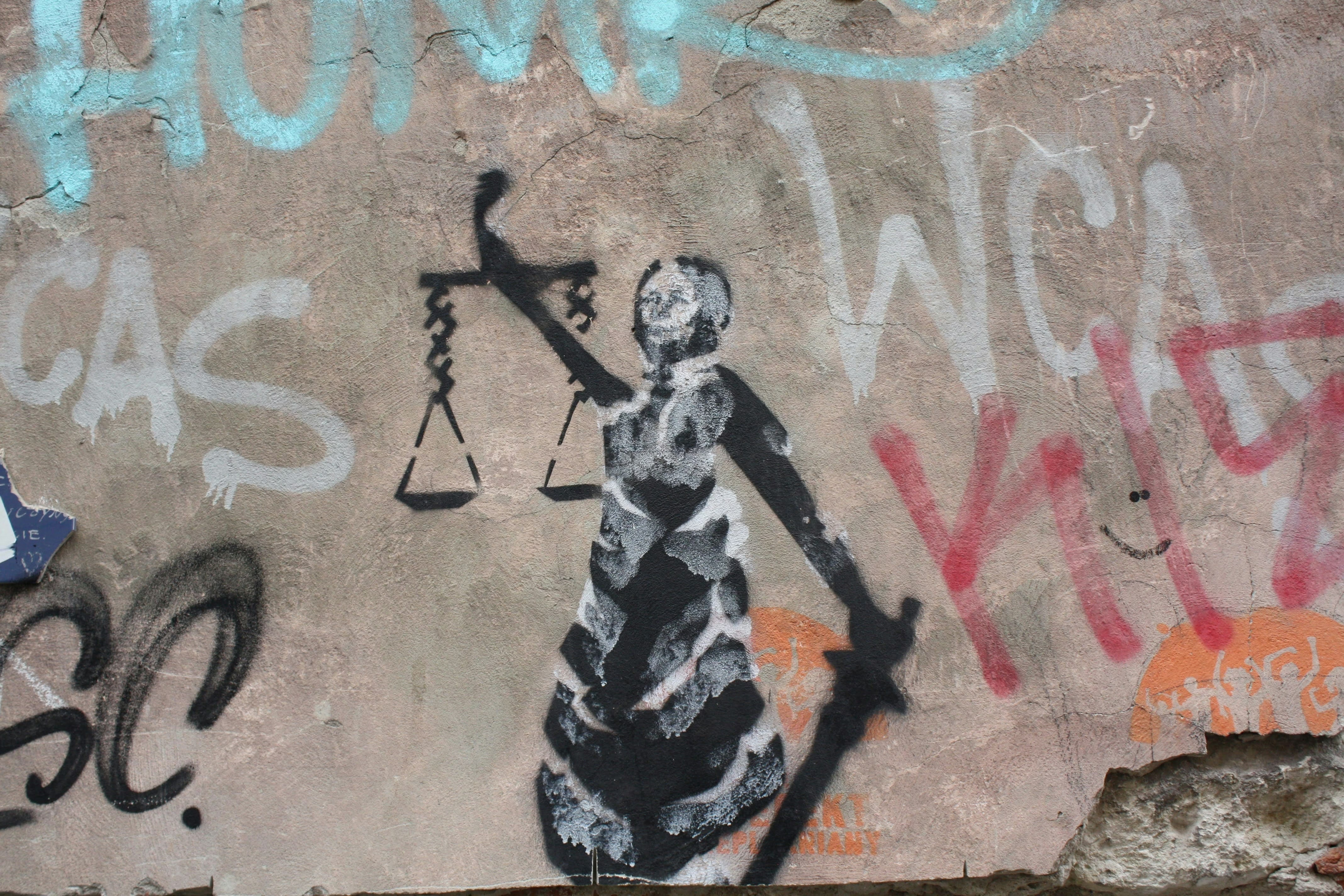
The theory of equilibrium says something both simple and unsettling: life is a zero-sum game of blessings. The universe maintains a kind of mathematical balance, a spreadsheet of what you own and possess. Not in your choices or your actions — in the inventory of your life.
The idea is simple: life works through equilibrium, and the universe runs on some cosmic accounting system in which every blessing comes with a hidden tax.
That theory doesn’t claim to be cruel. It claims to be fair.
It claims that moderation across all areas is the only realistic path to happiness. That perfection in one domain is, almost mathematically, the ruin of another. That the person who seems to “have it all” is, beneath the surface, paying a price you just can’t see yet.
And when you look around — genuinely look — it holds up terrifyingly well.
The Dilemma Of Sacrifice
We all know the celebrity with millions of followers, but nobody to trust. The businessman who owns three companies but barely knows his children. The exhausted medical student is trading sleep, health, and relationships for achievement. The poor old couple with very little money, somehow laugh more genuinely than wealthy people sitting in silence at expensive restaurants.
Now, the everyday guy quietly believes this theory and unconsciously acts on it. People begin to think happiness is not about fulfillment anymore, but about intentionally and carefully distributing misery. And our hustle culture constantly reinforces this belief.
A young man delays marriage because he thinks success requires loneliness.
A mother sacrifices her health in an effort to become the “perfect parent.”
Some even refuse to chase money because they fear becoming evil or corrupted.
The House MD Story
Life balance looks so attractive and almost spiritual as a theory that it has been used as a theme on the TV show House MD (Season 6, Episode 5), where a billionaire father believes his son’s incurable illness is some kind of karmic balance for his own success and wealth. After House tells him the disease is terminal, the father basically destroys his fortune on purpose — signing deals that will bankrupt him — hoping to “restore equilibrium” and save his son.

Islam’s Perspective: You’re Solving the Wrong Problem
Now, what is Islam‘s stance on this, and does this “theory” fit within our religious doctrine?
The answer is simply: NO!
Not because the balance in life is wrong or impractical, but because Islam rejects the premise itself: in Islam, fulfillment is never about ownership in the first place, whether it’s 100% or 30%; it has nothing to do with a peaceful or complete life!
The other premise in the equilibrium theory is that you are in control, whereas Islam’s premise is that your life is a test.
Islam describes life as a test, and more is a test, just as less is.
Attachment vs Ownership
According to Islamic teachings, it’s not the quantity or quality of your assets that harms you — it’s the attachment.
It’s not having more or less money that corrupts; it’s loving money above everything else. It’s not beauty that leads someone astray; it’s building your entire identity around it. It’s not success that breaks families apart; it’s the unexamined belief that success upholds the family.
The problem was never what’s in your hands. It was always what’s in your heart:
Two people can own the same amount of money: one sleeps peacefully, the other lives in constant fear of losing it.
Two people can experience sickness: one remains hopeful and emotionally stable, the other becomes bitter and depressed.
When Balance Becomes a Burden
And here’s the hard truth the equilibrium theory quietly avoids: how can you achieve balance on temporary ever-changing things, and even if granted and you achieved that perfect balance across every domain of life — precisely the right amount of wealth, health, love, purpose, beauty — you still wouldn’t be complete. Because those are “possessions”, and the destiny of every possession in a human life is ultimately the same: It either leaves you, or you leave it.
Furthermore, not having what you crave could be a blessing, and having what you want is not always a step closer to perfection. Beauty could make you a sinner, money can ruin your health, and strength can turn you into an arrogant, hated person: only God knows.
The Islamic Eqilibrium: Multiplication, Not Addition

Islam proposes something that sounds simple on the surface — but is actually radical once you sit with it.
In Islam, the real equilibrium is in the soul.
Happiness comes when you put your Creator on one scale and everything in your world on the other. Because if health, wealth, family or beauty are the source of your completion, God Almighty is the source of all that, so just go to the source.
And here comes the important part:
When your heart is directly related to the Giver rather than the gifts, the equation changes; life is no longer a sum equation but a multiplication one.
When interacting with your Creator, you neither add nor subtract your blessings and possessions; instead, you multiply them by strengthening your relationship with Him, His Wisdom, and His Mercy.
Peace and happiness come from your entire life and possessions multiplied by your relationship to God. And your attachment to the Provider makes losing or gaining money, family, health… not about more or less anymore, since it all comes from the same source, and that source is Infinite: Allah.
If the equilibrium equation suggests that receiving one blessing automatically reduces the others, then Allah has shown us that increasing your faith and obedience to Him enhances all aspects of your life, no matter their quantity or quality.
We have authentic stories of great scholars who found peace and fulfillment in prison or even execution, and kings surrounded by guards and servants who lived in toxic fear.
The Practical Balance
Now, all of the above was theoretical, and if you’ve read my articles, you would know that I am more of a practical guy.
Here’s the beautiful twist that purely philosophical discussions miss: in Islam, loving God is not just a feeling. It’s not a metaphysical orientation you hold in your head. It’s a lifestyle — a concrete, daily, embodied way of being in the world.
Obeying Allah means starting your day at dawn, working hard, being faithful and honest, turning away from illegal and forbidden money or relationships, avoiding and keeping distance from any sin, eating healthily, fasting, giving charity, keeping your dignity at any cost, putting your family above any material means, fighting for your rights and for the weak…
And that is a genuinely balanced life: structured, purposeful, Grounded in something beyond the market stocks or the number of followers. A life that simply works.

Final Reflection
Equilibrium in Islam comes from making the right decision at the right time in the right place and with the right person. And that’s impossible for us to achieve unless you have the guide or the handbook for it: God’s instructions.
So you can pretend you are in control and spend your life reaching for an impossible, painful balance, or you can pick up the manual, follow the factory instructions, and let God manage your balance, as He always does.
“And whoever is mindful of Allah, He will make a way out for them, and provide for them from sources they could never imagine. And whoever puts their trust in Allah, then He ˹alone˺ is sufficient for them. Certainly Allah achieves His Will. Allah has already set a destiny for everything.”
Quran 65:2-3